Google Cloud Dedicated: Architecting Sovereignty at Scale
Unlocking a $40B market by leading the design program behind Google Cloud's largest horizontal initiative
Some artifacts have been changed or omitted to comply with NDA.
IMPACT
As UX lead driving end-to-end design, I built the UX program, established the design patterns, and drove the cross-org alignment that took it from inception to GA launch.
THE BUSINESS OPPORTUNITY
Building a sovereign cloud from end-to-end to unlock a $40B market.
Strict data sovereignty laws in regions like France and Germany prohibited regulated industries from using hyperscale clouds. To capture this $40B market, Google set out to build a "Dedicated" cloud entirely run by local partners instead of Google employees.
Over 3 years, I led UX across 3 major workstreams centered around the core user groups:
Customer
How might we provide a familiar, high-performance experience while making sovereign restrictions clear and actionable?
Partner
How might we enable a third-party to operate, bill, and support a global cloud infrastructure without Google's intervention?
Googler
How might we build the internal tools for Google engineers to maintain hardware while legally isolated from customer data?
This case study focuses on the Customer Experience track. I defined the core platform experience (branding, navigation, and support) and established design directions for 100+ product teams (e.g. GCE, GCS, and BigQuery) on how to adapt their services for this new environment.
STRATEGIC ALIGNMENT
I translated regulatory complexity into a human-centered vision, aligning 100+ teams around a unified product scope.
When I joined, the initiative lacked a PRD, roadmap, or a clear sense of scope beyond raw regulatory requirements. I visualized the effort by creating ecosystem maps and high-level, end-to-end journeys — from resource provisioning to partner-led support. These visuals and human-centered stories gave stakeholders a tangible way to grasp the full breadth of the GCD experience for the first time. This work catalyzed the internal organization, providing the framework to structure a 1,000+ person engineering effort into three distinct tracks: Customer, Partner, and Googler experiences.
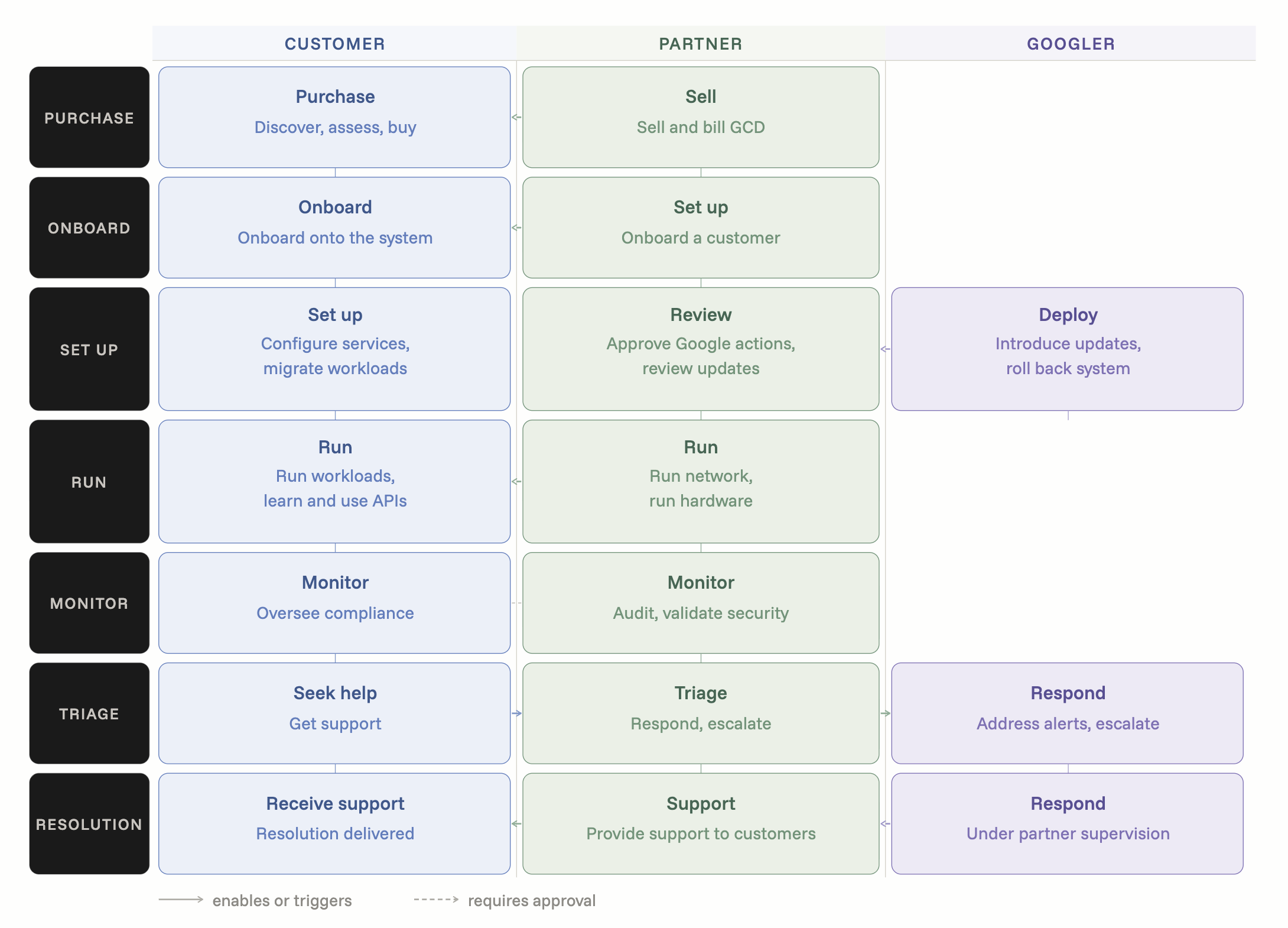 GCD Ecosystem map visualizing the high-level
landscape of roles and journeys.
GCD Ecosystem map visualizing the high-level
landscape of roles and journeys.
SCOPING THE WORK
I drove cross-functional service blueprinting to translate the high-level vision into PRDs with user-centered priorities.
I led product leaders through blueprinting sessions to visualize core end-to-end workflows, surfacing critical experiences we needed to address for the program to succeed. Strategic alignment drove the definition of PRDs and priority CUJs, providing leadership with the visibility to initiate critical workstreams and prevent a disjointed and incomplete product launch.
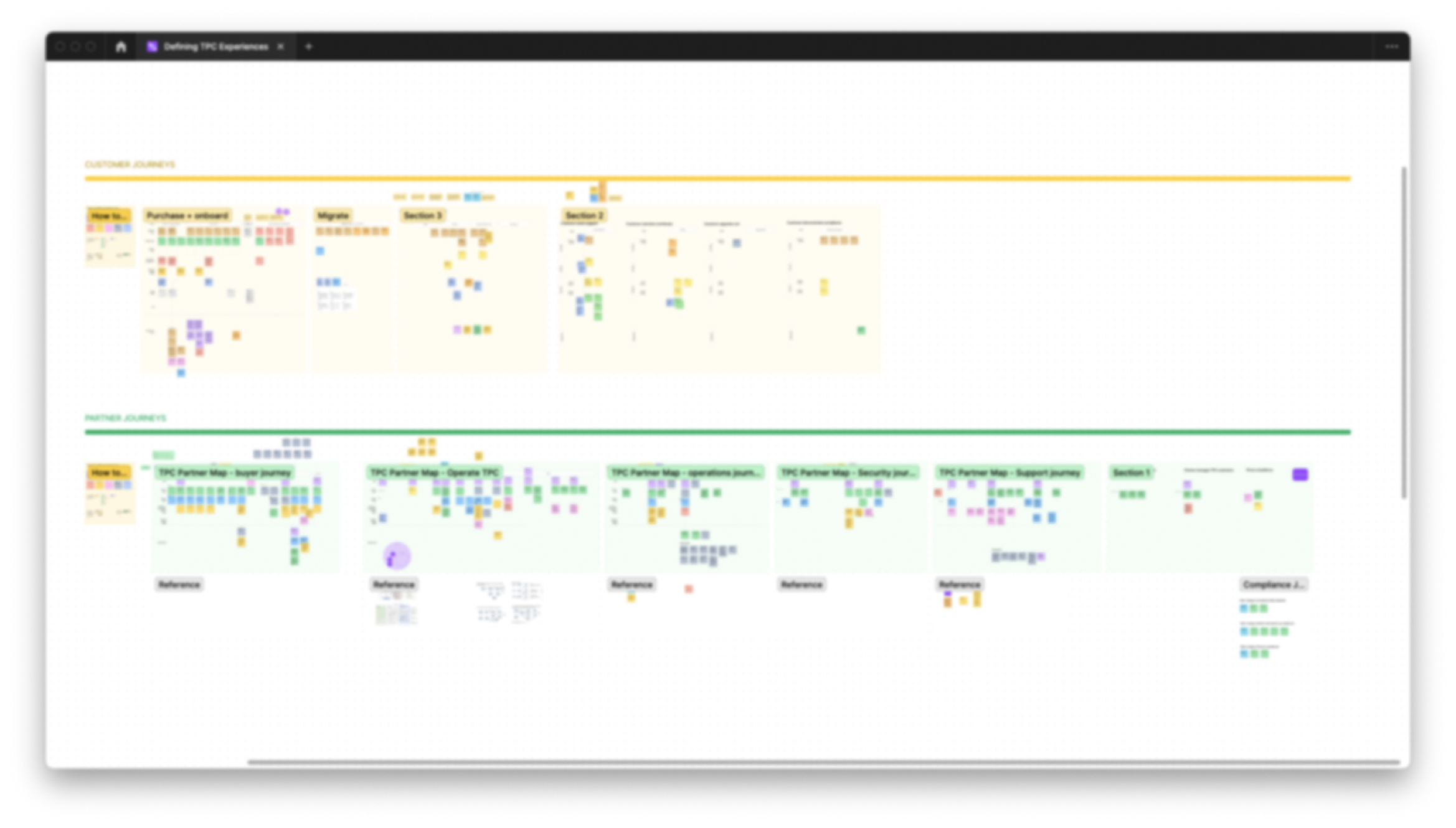 GCD service blueprint mapping touchpoints and key
experience gaps
GCD service blueprint mapping touchpoints and key
experience gaps
The blueprinting findings shaped the full UX program. I distilled them into defined workstreams across every GCD experience layer, and presented them to stakeholders to secure the cross-org alignment needed to execute.
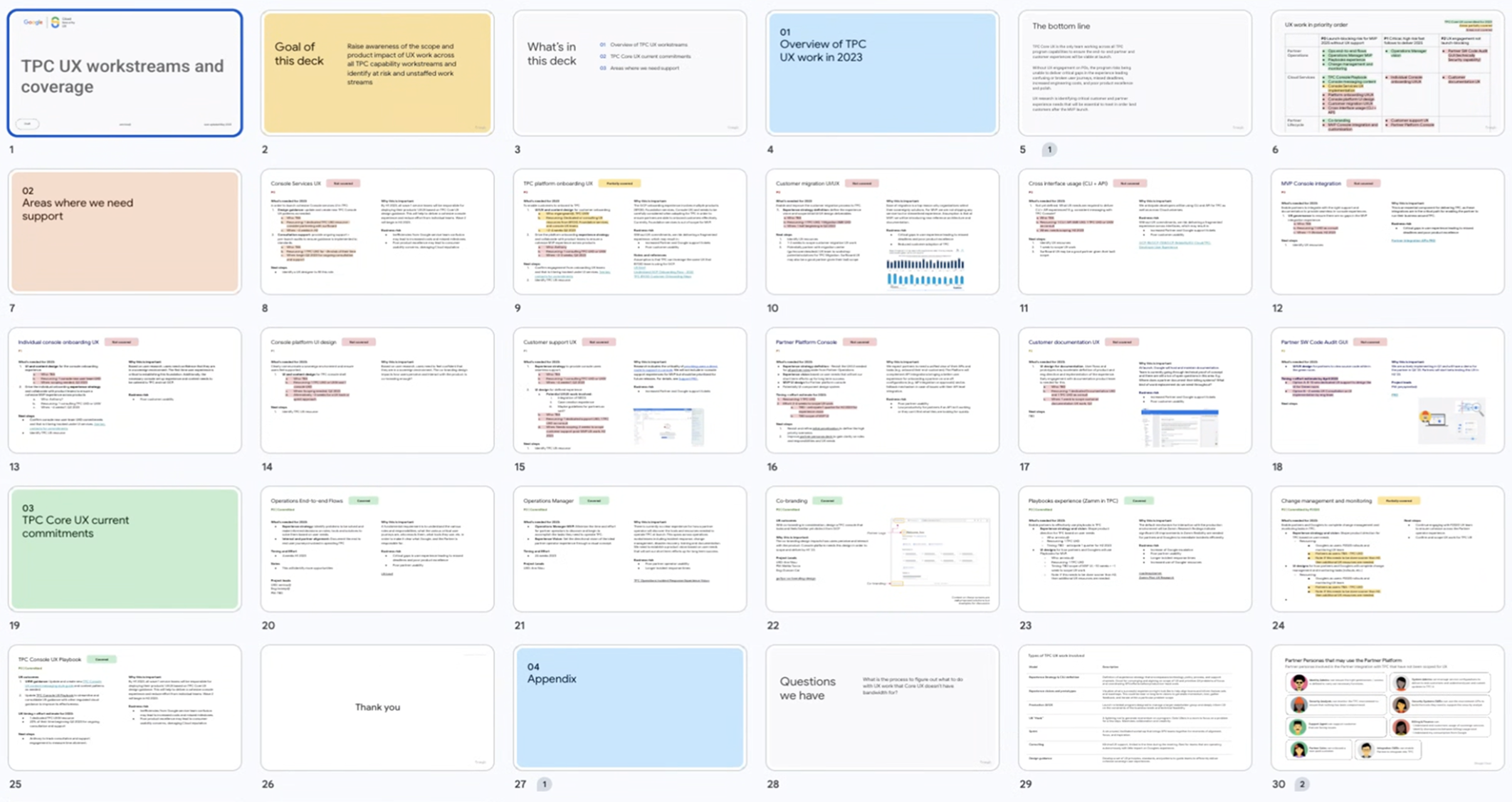 UX workstream coverage deck — scoped across the full GCD experience and presented to
stakeholders to align on program priorities
UX workstream coverage deck — scoped across the full GCD experience and presented to
stakeholders to align on program priorities
"She demonstrates a rare ability to fully absorb and account for technical limitations while tenaciously advocating for the best possible user experience... Ann successfully restructured the core user problems into coherent, crystallized workstreams, allowing the team to move from chaotic ambiguity to confident execution."
RESEARCH & AUDIT
I led a platform-wide audit that streamlined and scaled UX discovery across 50+ product teams.
While the service blueprints showed us the types of changes needed, it would have been impossible for me to manually identify and design for the specific UI impact across 100+ products. Stakeholders initially assumed the GCD experience was a simple exercise in adding partner branding and hiding features, but I knew that regulatory and technical requirements would break core parts of the standard Google Cloud experience if not addressed properly:
Regulatory restrictions
Identifying "Google" branding and legal references that created jurisdictional ambiguity.
Feature gaps
Out-of-scope features with no clear messaging or path forward.
Diversion points
Where users would need to be redirected to partner-led support, billing, operations, or documentation.
To take a more systemic approach to addressing these changes at scale, I built a self-service UX audit framework and led the effort to identify where the standard Cloud experience broke under sovereign constraints due to regulatory rules or technical limits. By decentralizing the audit, I was able to quantify the total scope of UX work and identify the UX gaps and patterns of impact across the platform in 3 weeks.
The findings I synthesized defined both UX and UI engineering requirements for all product feature teams and directly shaped the Customer Console PRD.
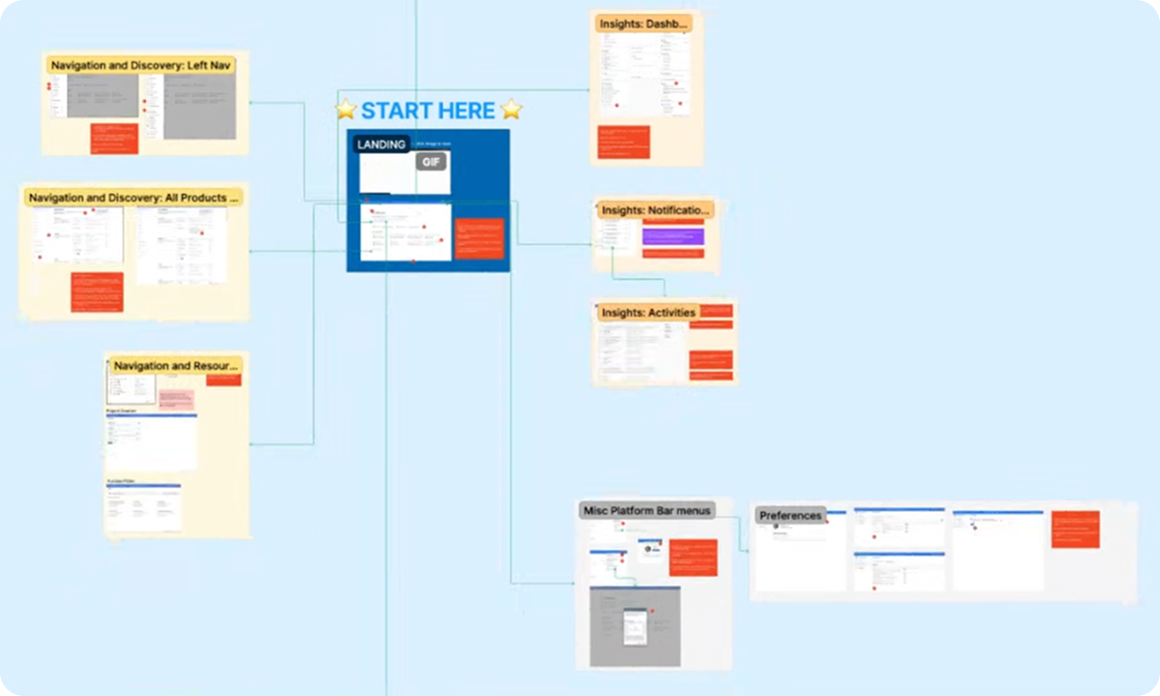 Example UX audit created from template
"Ann is not only a fantastic designer — she is a force-multiplier who helps teams work better. Ann asks the tough questions and shepherds those lucky enough to work with her through a thoroughly user-centered design process that aligns stakeholders and focuses teams on the outcomes that matter most to their users."
PROTOTYPING & DESIGN DECISIONS
I overturned a high-risk assumption through user research, shifting the strategy from simple rebranding and hiding features to transparent, in-context guidance.
The audit confirmed for me that simply adding co-branding and "hiding" discrepancies wouldn't meet user's needs. Users moving between standard and sovereign environments would face jarring inconsistencies — a gap that had historically led to the failure of similar initiatives, such as Microsoft's 2016 "Data Trustee" model in Germany.
To test my hypothesis that users required significantly more transparency, I prototyped two versions of a core VM creation flow: a "minimal" branding approach vs. a version with explicit, in-context explanations for every restriction.
Participants unanimously preferred the explicit, in-context approach. In a regulated environment, providing the reason and implication behind a constraint is table stakes for users to act with confidence.
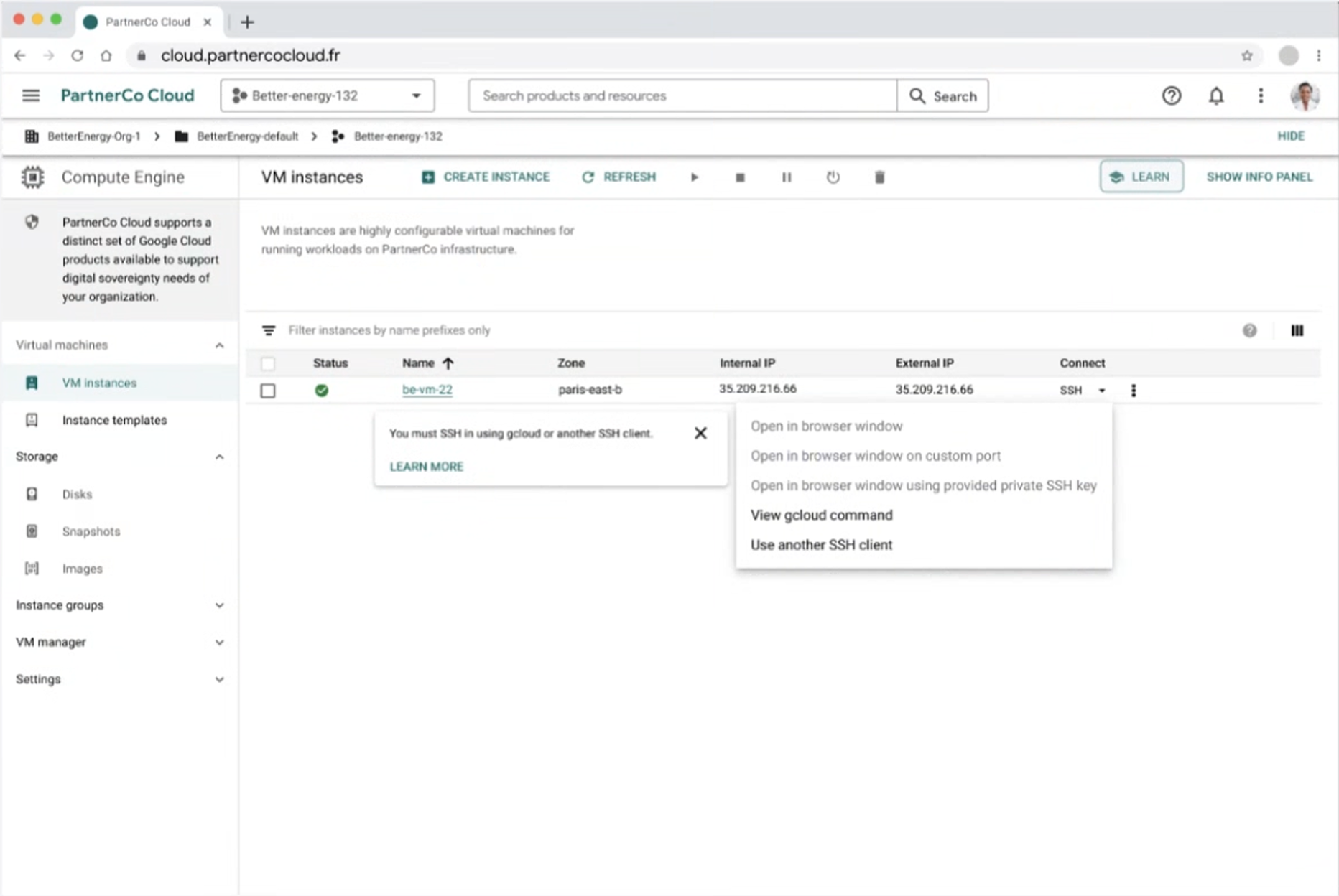 Example prototype screen tested with users
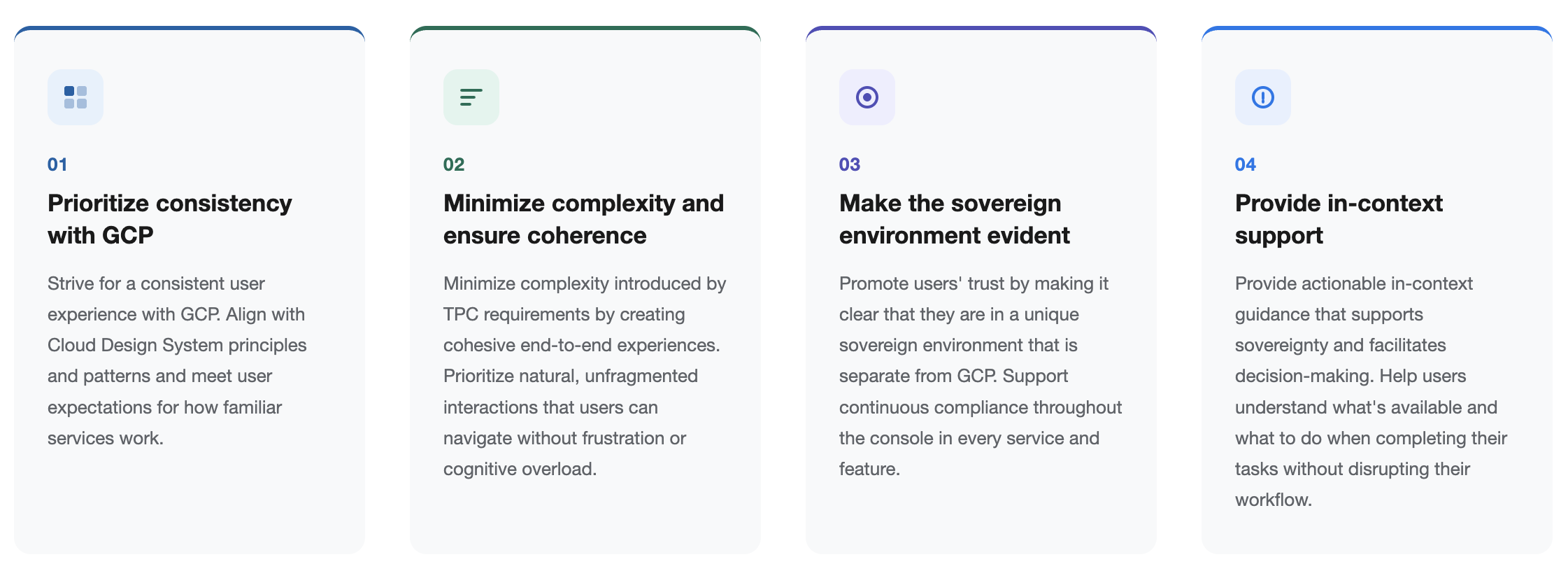
I established four foundational UX principles based on these insights to ground design decisions across the platform, giving every team a shared framework to make decisions from:
Parity with GCP
Prioritize familiar patterns to reduce cognitive load in a constrained environment.
Coherence over Complexity
Surface constraints proactively and early in the task, not mid-flow.
Continuous Awareness
Make the sovereign environment evident across every surface to prevent jurisdictional ambiguity.
In-Context Support
Provide actionable guidance at the exact point of divergence.
SYSTEMIC SOLUTIONS
I evolved the Cloud Design System and Global Console shell to support GCD requirements, streamlining design and reducing engineering overhead across 50+ services.
1. Redefining the Console Shell experience from co-branding to user situational awareness
The challenge: The initial product directive was to simply add partner branding to the UI. I recognized that this conflated a product branding goal with a critical user need for contextual awareness in highly regulated environments. I discovered that this lack of persistent environmental context was also a known gap in the standard GCP experience.
The solution: I purposefully decoupled the branding requirement from the functional user need. I partnered with the GCP console team to design a Scope Selector and Jurisdictional Indicator as persistent shell components that solved this contextual gap across both GCD and the standard GCP console.
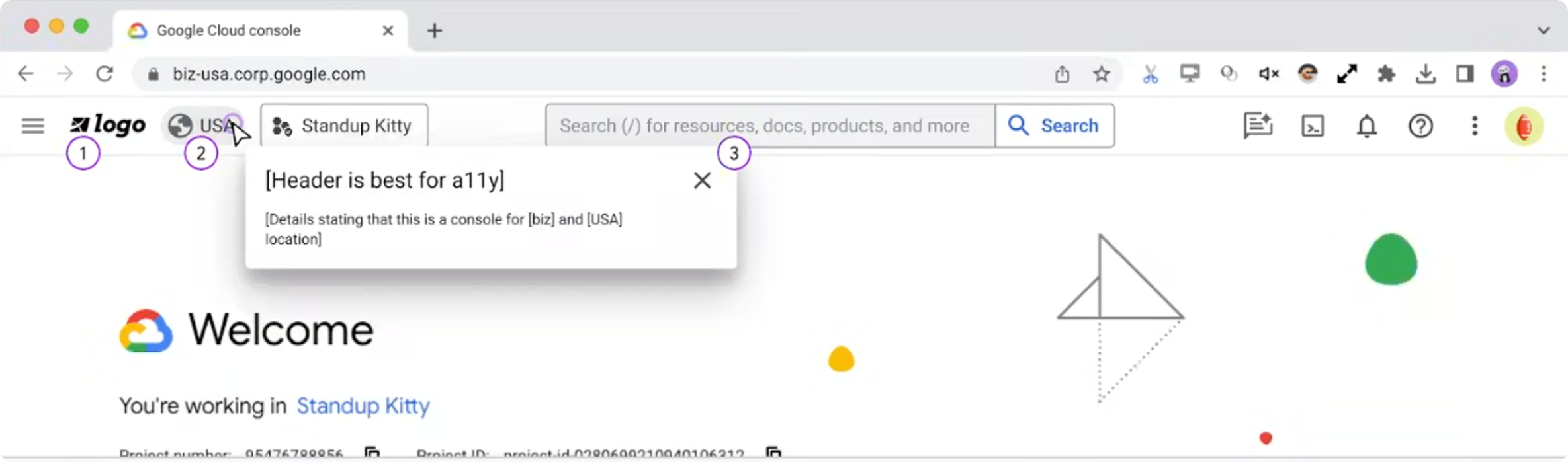 Lockup of Brand Logo (1), Jurisdictional Indicator (2,3), and
Scope Selector — persistent shell components that gave users continuous awareness of their
sovereign environment.
Lockup of Brand Logo (1), Jurisdictional Indicator (2,3), and
Scope Selector — persistent shell components that gave users continuous awareness of their
sovereign environment.
2. Expanding the Cloud Design System to support sovereign requirements at scale
The challenge: Over 50 product teams needed to modify their surfaces to comply with GCD regulations. The existing Cloud Design System lacked foundational guidance on how to restrict or remove features. Without a shared UI standard, we risked visual fragmentation, inconsistent compliance implementation, and redundant engineering overhead.
The solution: Based on our user research insights, I authored the Regulated Cloud Design System guidance — a comprehensive UX design system guide that standardized compliance patterns not just for GCD, but across all regulated Google Cloud offerings.
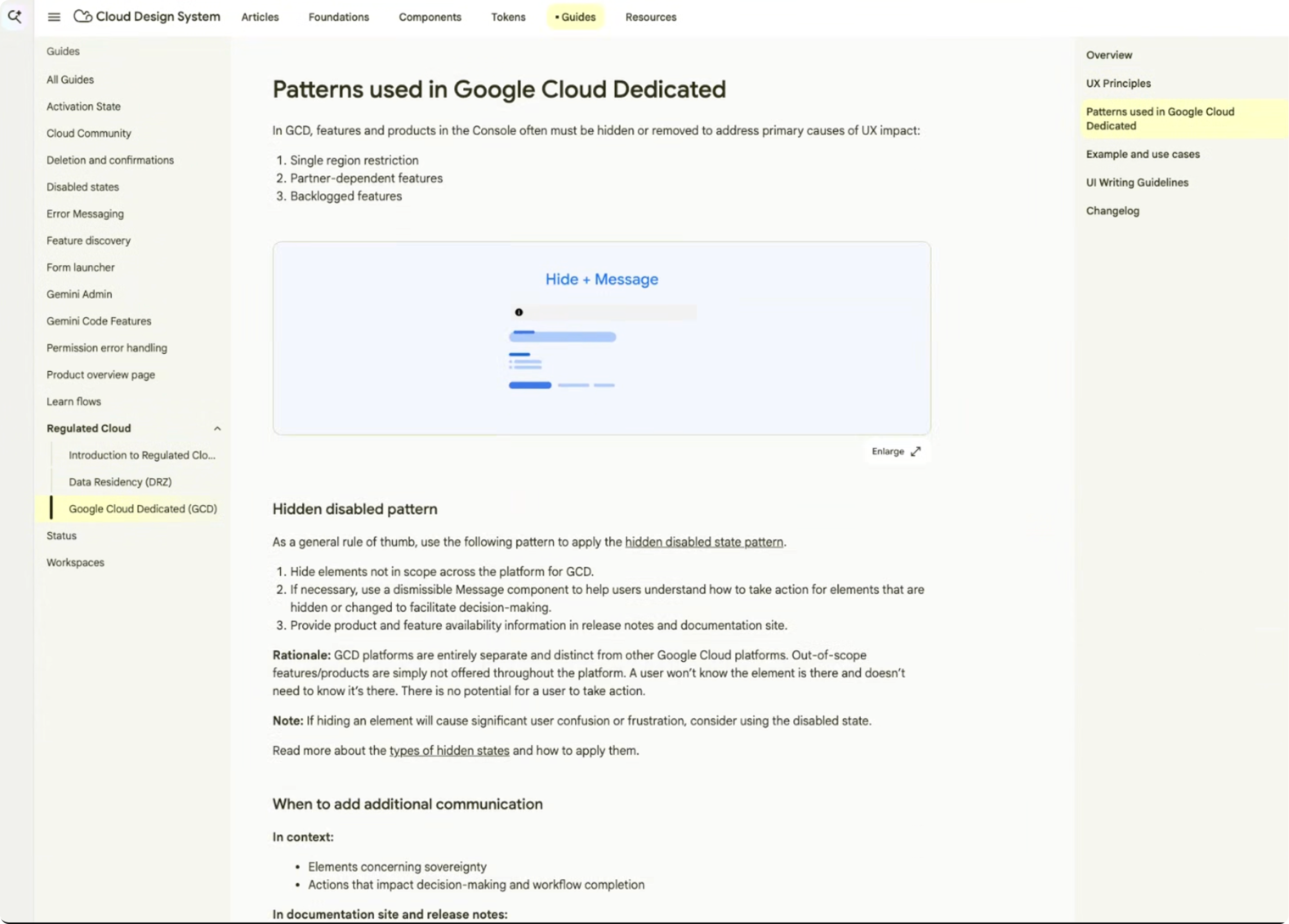 Google Cloud Dedicated guidance in Cloud Design System.
Anatomy of the Google Cloud Dedicated guidance
UX Principles
Empowering autonomous execution
The foundational set of UX principles I developed through research guided the overall design direction, giving 50+ product teams shared logic for designing coherent, bespoke UIs without requiring my direct oversight.
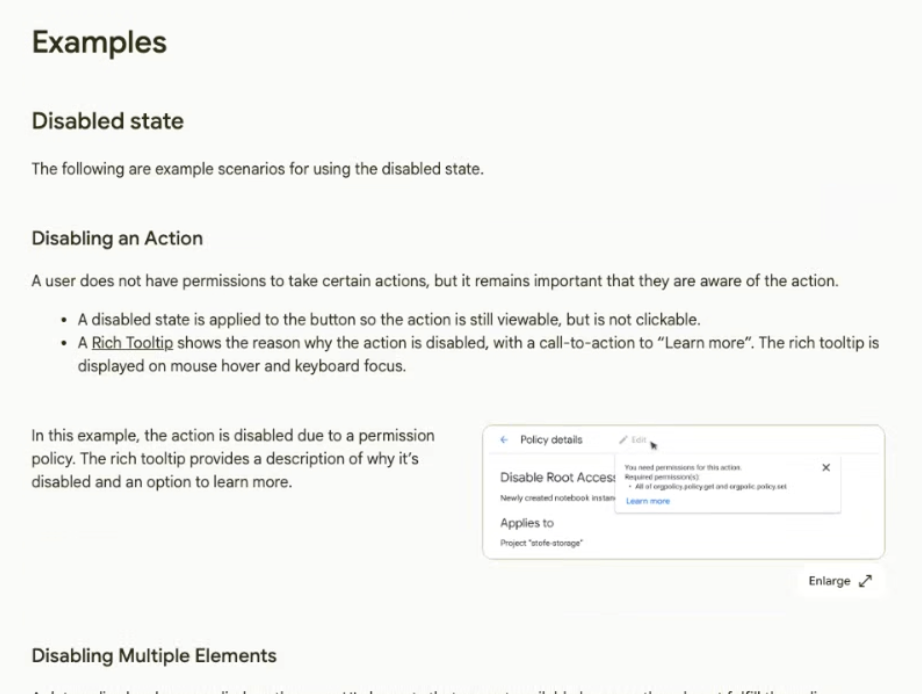
Disabled States Pattern
Systematizing feature restrictions
I authored the global Cloud Design System pattern for exactly how and when to use Disabled, Hidden, and Read-Only states, preventing visual fragmentation across the platform.
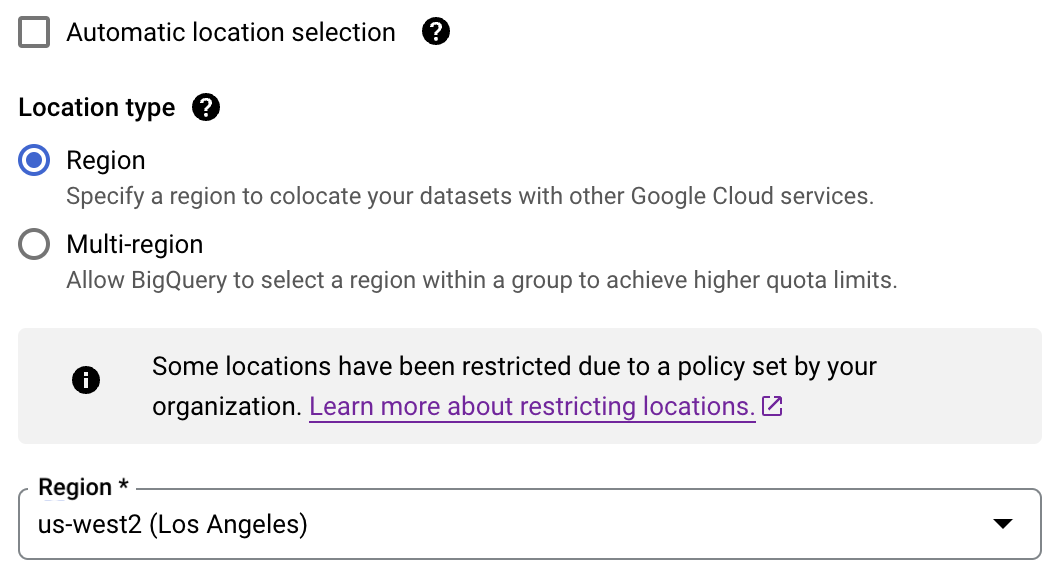
Core Components
Eliminating custom engineering code
I partnered with CDS engineering to natively add built-in configurations to existing core components — for example, introducing a read-only state for single-option selects, enabling product engineers to surface regional restrictions without writing custom code.
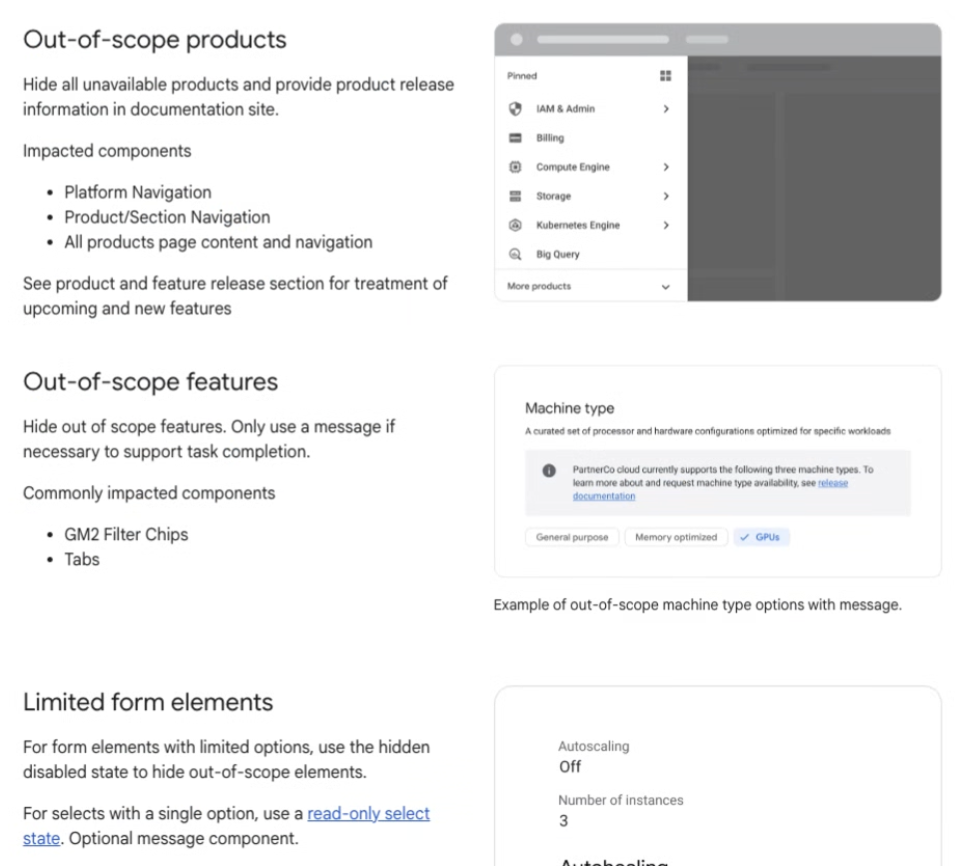
Examples and Use Cases
Solving for common patterns
I developed solutions for common patterns revealed through the audit that required prescriptive designs — for example, updating the global Location Selection component to include an optional message configuration to consistently surface sovereign context.
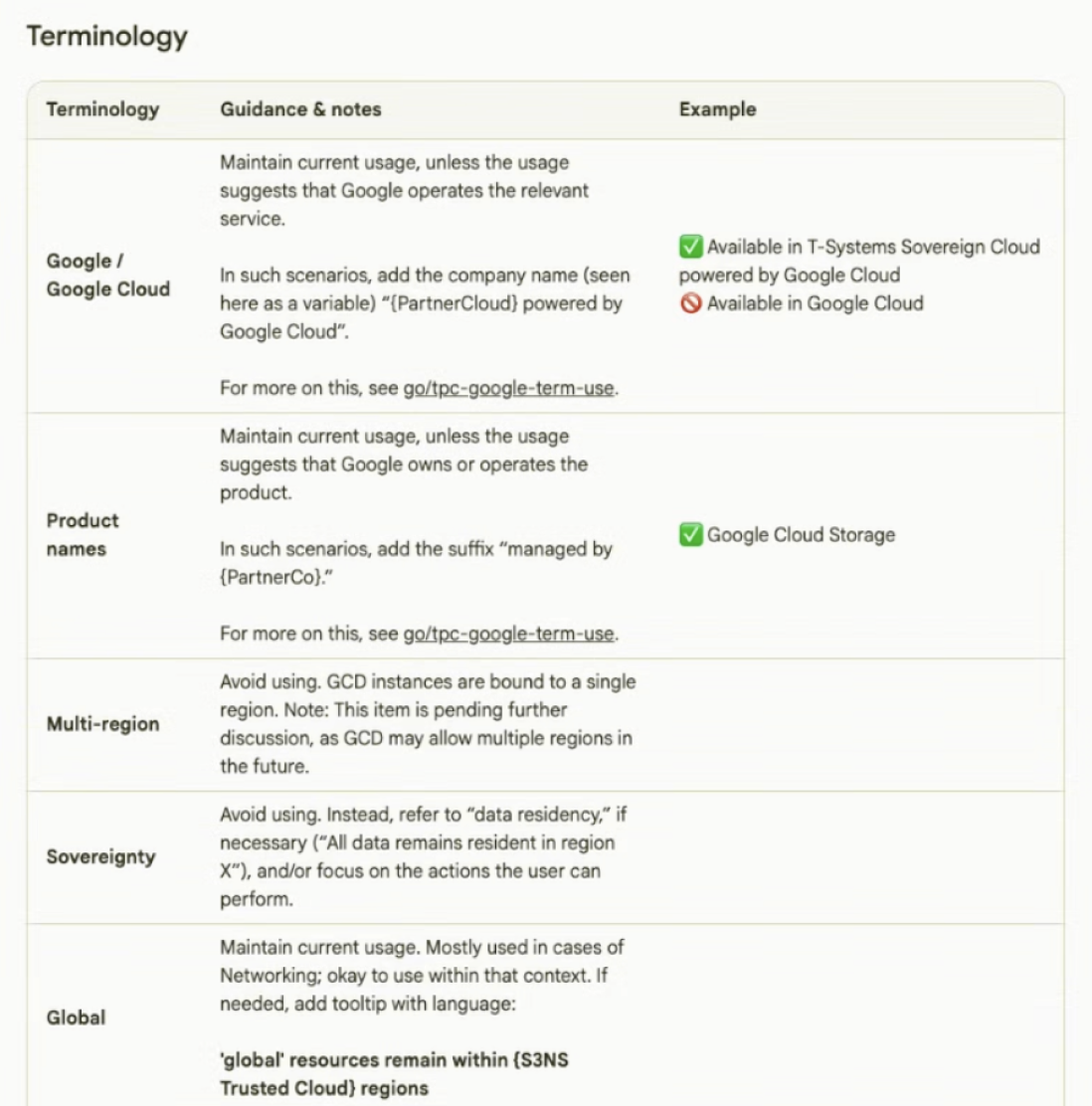
Content Guidelines
Balancing transparency with security
I guided a new content designer to establish global language standards, creating reusable templates that clearly communicated regulatory context to users without exposing underlying platform vulnerabilities.
OUTCOME & IMPACT
Scaling design consistency for a $40B complex sovereign cloud ecosystem.
PREMI3NS, the Google Cloud Dedicated solution offered by S3NS for France, is now in General Availability with 70+ customers. By establishing system-level design standards and program-wide processes, product teams have been successfully shipping coherent products without looping me in.
The systems and processes I established alongside Product and Engineering created a resilient, user-centered development cycle that holds up even when specific requirements may evolve. Today, this process continues to drive development of future dedicated Clouds. T-Systems Sovereign Cloud in Germany is already well underway.
Some highlights of my contributions include:
Design as a prerequisite, not an afterthought
Successfully embedding the UX audit as a required discovery step in the program-wide service integration guide was a significant shift for an org that had historically been engineering-driven, ensuring design was part of the process from day one.
Scaling design autonomy
By decentralizing the design process and establishing robust pattern guidance, empowering teams, and removing myself as an execution bottleneck.
Shared language with 100+ engineering teams
Codifying regulated cloud patterns on the internal Cloud design system site provided a single source of truth, enabling engineers to implement regional restrictions natively.
Visuals to drive cross-functional alignment
Collaborative ecosystem and service blueprinting drove rapid alignment across a massive program. Prototyping competing experiences early in the process overturned risky stakeholder assumptions.